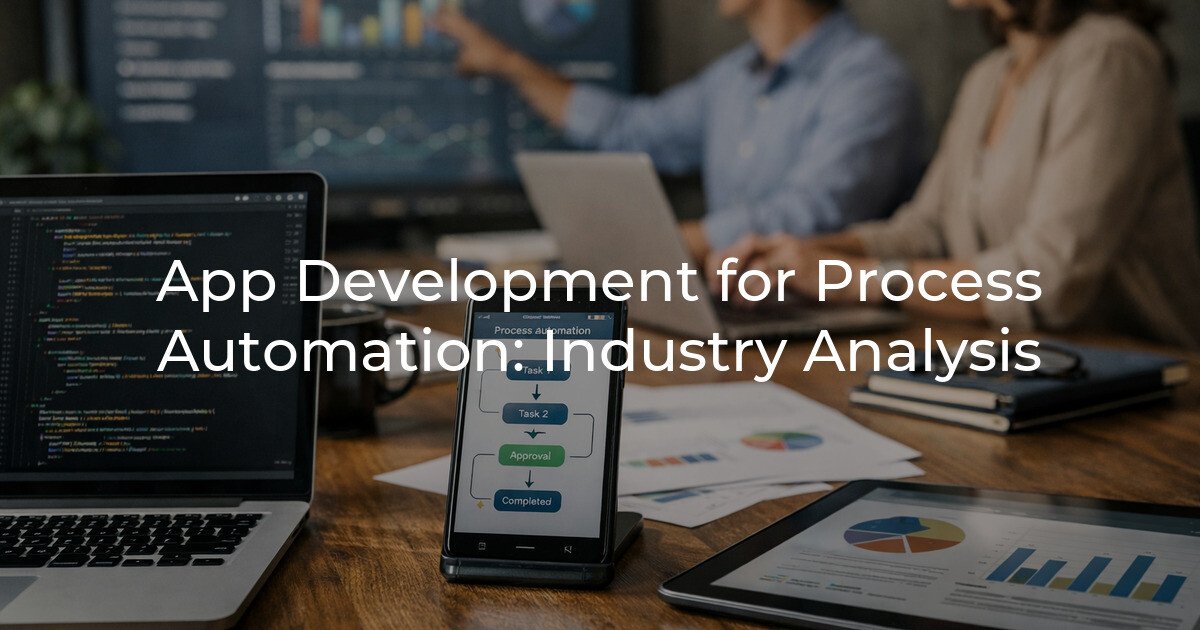
App Development for Process Automation: Industry Analysis
If your “process” lives in a spreadsheet tab, an inbox, and a Slack thread, you don’t have a workflow—you have a memory test. It works until volume jumps, one person goes on vacation, or a customer asks for a status update you can’t answer without chasing three teams. That’s where App Development earns its keep: turning scattered work into a system that routes decisions, enforces required data, and shows progress in real time.
The symptoms look familiar. Requests sit in limbo because no one owns the queue. Approvals happen in side conversations and get lost. People retype the same fields into CRM, ERP, accounting, and ticketing tools, then argue about which record is current. Managers end up running the business off screenshots and weekly check-ins because there’s no single place that reflects what’s actually happening.
This article breaks down when custom business apps beat spreadsheets or SaaS, which workflows deliver fast ROI, and why system integrations, workflow design, and secure app development decide whether process automation improves throughput or creates new risk. You’ll leave with a practical way to pick what to automate first, measure the impact, and keep the automation reliable as the business changes.
When Does Custom App Development Beat Spreadsheets or SaaS?
Once you define intake, validation, approvals, and traceable outcomes, the next question is where App Development belongs. Spreadsheets and email chains fail when work needs routing, permissions, and audit trails. Many SaaS tools solve common workflows, but they break down when your process depends on deep integrations, offline execution, or a data model that does not match the vendor’s assumptions.
Custom app development beats spreadsheets or SaaS when the workflow has requirements that generic tools cannot meet without brittle workarounds.
- Complex approvals and exceptions: Multi-step routing (role-based, dollar thresholds, conditional approvers), parallel reviews, escalations, and rework loops. If your “approval” lives in Slack or email, you lose accountability and cycle-time metrics.
- Offline or edge connectivity: Field inspections, warehouse scans, or job-site checklists that must run on iOS/Android and sync later. Tools like Airtable or Smartsheet can struggle here without custom mobile logic.
- Unique data model: If you need parent-child records, versioning, item-level traceability, or custom calculations, spreadsheets become fragile and SaaS often forces compromises.
- Compliance and auditability: Immutable logs, e-signatures, retention rules, and access controls for regulated work. In the US, workflows touching HIPAA or SOC 2 controls often need tighter governance than a shared spreadsheet can provide.
- Integration depth: Bi-directional sync with Salesforce (CRM), NetSuite (ERP), QuickBooks (accounting), Jira Service Management (ticketing), or Snowflake (data warehouse). If staff retypes data between systems, you have an integration problem, not a training problem.
Build vs Buy vs Automate Rubric
- Buy SaaS when the process is standard and configuration covers 80 percent of needs (examples: ServiceNow for IT workflows, Zendesk for support).
- Automate on top when the tool is right but handoffs are manual, use Zapier, Make, or Microsoft Power Automate to connect systems and enforce rules.
- Build a custom business app when you need offline-first execution, strict permissions, a custom data model, or integrations that must be reliable at scale.
Teams usually start with automation, then move to custom apps when exceptions, security, and integrations become the real work.
Which Workflows Deliver the Fastest Automation ROI?
Exceptions and integrations usually decide whether App Development pays off, but workflow selection decides how fast you see ROI. The fastest wins come from processes with high volume, frequent handoffs, and clear “done” states. You want repeatable work where a custom business app can enforce required fields, route decisions, and write clean data back to systems of record.
- Intake and Approvals: Start by replacing email requests with a structured intake form (required fields, attachments, validation). Automate routing by rules (department, dollar threshold, location) and add SLA timers plus reminders in Slack or Microsoft Teams. Capture decision reasons so you can reduce back-and-forth later.
- Field Service: Automate schedule-to-completion with a mobile app that supports offline mode and sync. First automations: job check-in/out timestamps, photo capture, parts used, and customer sign-off. Push updates to ServiceNow (ITSM) or Salesforce Service Cloud so dispatch and billing see the same status.
- Inventory and Asset Tracking: Start with barcode or QR scanning tied to a single asset record. Automate check-in/check-out, cycle counts, and reorder triggers. Integrate with NetSuite or SAP for item masters and with a ticketing tool like Jira Service Management for lost or damaged assets.
- Customer Onboarding: Automate the handoff from “closed-won” to provisioning. First steps: collect required legal and security info, generate tasks by customer segment, and gate progression until prerequisites clear. Sync accounts and contacts with Salesforce or HubSpot CRM so teams stop duplicating records.
- Compliance Checklists: Start by converting static documents into step-based checklists with evidence capture (files, timestamps, approver identity). Add immutable audit logs and exception paths for waivers. Common targets include SOC 2 readiness tasks and HIPAA-adjacent operational controls in healthcare workflows.
- Internal Dashboards: Start with operational metrics that answer “what is stuck?” not vanity charts. Automate daily refresh from systems like QuickBooks Online, Zendesk, and Snowflake. Add alerts when cycle time, backlog, or error rates cross thresholds.
If a workflow touches revenue recognition, regulated data, or multi-system updates, prioritize it early. Those processes carry the highest hidden cost when they fail quietly.
How Do Integrations Actually Work in Process Automation?
Revenue recognition, regulated data, and multi-system updates fail quietly when integrations are weak. In process automation, App Development often succeeds or fails on one question: how does data move between Salesforce, NetSuite, QuickBooks, Jira Service Management, and the databases that actually run operations?
An integration is a defined contract between systems: what event triggers a change, what data moves, where it is validated, and what happens when something breaks. Good integrations prevent “shadow systems” where teams retype data into spreadsheets because they do not trust sync.
Integration-First Patterns That Scale
- APIs (request-response): Your app calls a REST or GraphQL API to create, read, update, or delete records. Example: create a NetSuite vendor bill after an approval completes, then write the bill ID back to the custom app.
- Webhooks (event push): A system sends an HTTP callback when something changes. Example: Stripe fires a webhook on payment success, your workflow updates an onboarding status and opens a Jira Service Management ticket.
- iPaaS (integration platforms): Tools like MuleSoft, Workato, Boomi, Zapier, Make, and Microsoft Power Automate connect SaaS apps with managed connectors, retries, and mapping. Use iPaaS for common sync patterns and to reduce custom code.
- Event queues (asynchronous messaging): Systems publish events to AWS SQS, Amazon EventBridge, Apache Kafka, or RabbitMQ. Consumers process them later. Queues handle bursts, isolate failures, and keep front-end apps responsive.
Most teams mix patterns. APIs handle reads and transactional writes. Webhooks and queues handle change propagation.
Prioritize integrations that eliminate re-entry between:
- CRM: Salesforce, HubSpot
- ERP and accounting: NetSuite, Microsoft Dynamics 365, QuickBooks Online
- Ticketing and ops: Jira Service Management, ServiceNow
- Warehouses and analytics: Snowflake, BigQuery
- Internal data: PostgreSQL, Microsoft SQL Server
Integration quality comes from boring details: idempotency keys, retries with backoff, dead-letter queues, field-level validation, and clear ownership for every system of record.
The Contrarian Rule: Don’t Automate a Broken Process—Instrument It
Idempotency keys and retries keep integrations reliable, but they cannot rescue a workflow that no one can explain. Before you fund App Development for process automation, instrument the process so you can see where work actually stalls, why it bounces back, and which exceptions consume human time.
Instrumenting means you add measurement and traceability to the current flow, even if people still do steps manually. You turn “tribal knowledge” into explicit data: who did what, when, and with which inputs. That prevents “faster chaos,” where automation accelerates rework and hides root causes behind a slick UI.
App Development Starts With Baselines, Exceptions, and Auditability
- Map the real workflow, not the happy path. Run a 60 to 90 minute session with the operators. Capture handoffs, required fields, and every “we usually email Bob” exception. Write down the top 10 exception types and how often they occur.
- Add lightweight event logging. Track timestamps for intake, first touch, approval, rework, and completion. Store reason codes for rejects and reassignments. Even a temporary form in Microsoft Forms or Google Forms feeding a spreadsheet can produce usable baseline metrics.
- Define “done” and ownership. Pick one system of record per object (request, asset, customer). Assign an owner for each queue. If ownership is fuzzy, automation will route work into dead ends.
- Design human-in-the-loop gates. Automate the routing and validation. Keep humans for judgment calls like policy exceptions, credit holds, or safety sign-offs. Record who approved and why.
- Build auditability early. Require immutable history for status changes, field edits, and attachments. This matters for SOC 2 evidence collection and HIPAA-adjacent operational workflows in the US.
- Automate after you can measure. Baselines like median cycle time, rework rate, and cost per transaction tell you where automation pays. They also give you a before-and-after ROI story.
Teams that follow this sequence ship smaller, safer automations. They also avoid custom business apps that encode yesterday’s workarounds into tomorrow’s “standard process.”
Security and Governance That Keep Automations From Becoming Liability
Teams that instrument processes quickly run into the next constraint: risk. As App Development pushes approvals, payments, and customer data through automated paths, weak security turns a workflow win into an audit finding or a breach. Governance keeps process automation reliable when more teams, vendors, and integrations touch the same system.
Security starts with access design, not a login screen. Use RBAC (role-based access control) mapped to job functions, then enforce least privilege at the API and data layer. In practice, that means field-level permissions (view SSN, edit bank details), environment separation (dev, staging, production), and short-lived credentials via an identity provider like Okta or Microsoft Entra ID (Azure AD).
Audit logs are operational tooling. Log who did what, when, from where, and what changed. Make logs tamper-resistant, exportable, and retained long enough for your obligations. Many teams centralize logs in Splunk, Datadog, or the ELK Stack (Elasticsearch, Logstash, Kibana) so security and operations can investigate incidents without asking engineers for database access.
Secure APIs keep integrations from becoming your weakest link. Require TLS, validate input, and sign or verify webhook payloads (Stripe and GitHub both document webhook signature verification patterns). Implement rate limits, idempotency keys for write operations, and explicit error handling so retries do not duplicate transactions.
How Governance Changes as Automations Scale
One team can manage automation with informal rules. Cross-team automation needs a light but explicit operating model:
- Data classification: Define what counts as public, internal, confidential, and regulated (HIPAA, PCI DSS), then enforce storage and sharing rules.
- Change control: Use pull requests, code owners, and approvals for workflow rules, integration mappings, and permission changes.
- Retention and deletion: Set retention by record type (invoices, HR files, support tickets) and automate deletion or archival.
- Ownership: Assign a business owner and a technical owner for each workflow, plus an on-call path for failures.
Good governance keeps custom business apps fast to change without becoming a liability.
How JAMD Technologies Delivers Automation-Ready App Development
Governance keeps a workflow safe; delivery discipline keeps it usable. For automation work, App Development fails when teams ship a “version 1” and then treat operations as a static target. JAMD Technologies builds automation-ready apps with a lean method that assumes processes, integrations, and policies will change.
The goal stays operational: fewer handoffs, shorter cycle time, clean data written back to systems of record, and audit trails you can defend.
Automation-Ready App Development Delivery, End To End
- Discovery That Starts With Metrics: JAMD Technologies begins by defining the workflow’s baseline (median cycle time, rework rate, backlog age) and the system of record for each object. The team documents exception paths, approval rules, and required evidence for compliance.
- Prototype The Workflow Before Building The Platform: A clickable prototype (or thin “walking skeleton” build) validates screens, statuses, and routing rules with operators. This step flushes out edge cases like partial approvals, missing attachments, offline capture, and escalation timing before they become expensive.
- Iterative Releases With Integration Tests: Releases ship in small slices: intake, then routing, then integrations, then dashboards. Integrations get explicit failure handling (retries, idempotency, dead-letter queues where needed) so Salesforce, NetSuite, QuickBooks Online, Jira Service Management, and Snowflake do not drift into new silos.
- Change Management That Matches Real Work: Training focuses on roles and queues, not app tours. Teams get runbooks, ownership for each queue, and escalation paths when automation hits an exception.
- ROI Tracking And Continuous Improvement: Every automation ships with measurable targets, such as reducing cycle time by a defined percentage or cutting manual touches per transaction. Dashboards and alerts keep performance visible, and ongoing support keeps rules, permissions, and integrations current as operations evolve.
If you want a practical next step, pick one workflow with high volume and clear “done,” instrument it for two weeks, then use those baselines to scope a first release that removes one handoff end to end.